How AI Workloads Are Redefining UPS for Data Centers
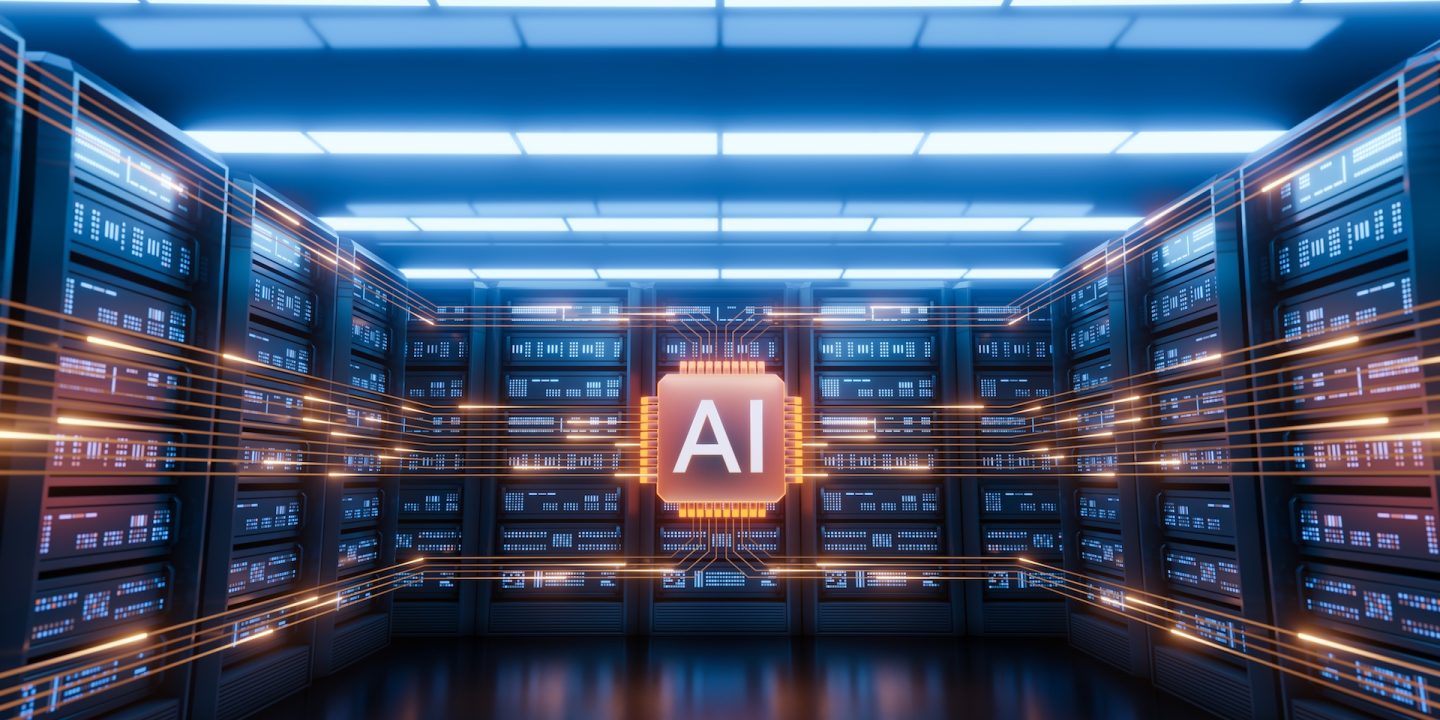
Traditional data centers were designed for workload that requires around 15 kW per rack. The numbers have changed since AI was introduced, pushing workloads even up to 120 kW per rack, as reported by Dell’Oro Group. With this shift, AI workloads demand more power and new planning and strategies on power consumption and cooling strategies, including power systems such as Uninterruptible Power Supply (UPS).
The reason behind the jump in power demand is largely in the hardware. Traditional data centers relied mainly on Central Processing Units (CPUs), which ran at roughly 150–200 watts per chip. AI workloads, on the other hand, require Graphics Processing Units (GPUs), and modern AI chips use anywhere from 700 to 1,200 watts each. A single AI server rack can consume 12–15 kW continuously, compared to the 7–10 kW typical of conventional racks.
Infrastructure that was engineered for stable, predictable loads is now being asked to absorb sudden surges and sharp drops in power demand. At the front line of that pressure is the UPS. What was once considered a passive safety net is now one of the most crucial components in an AI-era data center.
What Is Power Density and Why It Matters for AI Infrastructure
Power density is the amount of power measured in kilowatts (kW) that’s being consumed by a single server rack. The higher the density, the more computing power that rack can support.
AI workloads consume a lot of energy. In the U.S. alone, data centers represent 4.4% of total electricity consumption. It’s also predicted that by 2028, 165-326 TWh will be used. And as reported by International Energy Agency (IEA):
“Our Base Case finds that global electricity consumption for data centres is projected to double to reach around 945 TWh by 2030 in the Base Case, representing just under 3% of total global electricity consumption in 2030. From 2024 to 2030, data centre electricity consumption grows by around 15% per year, more than four times faster than the growth of total electricity consumption from all other sectors. However, in the wider context, a 3% share in 2030 means that data centre share in global electricity demand remains limited.”
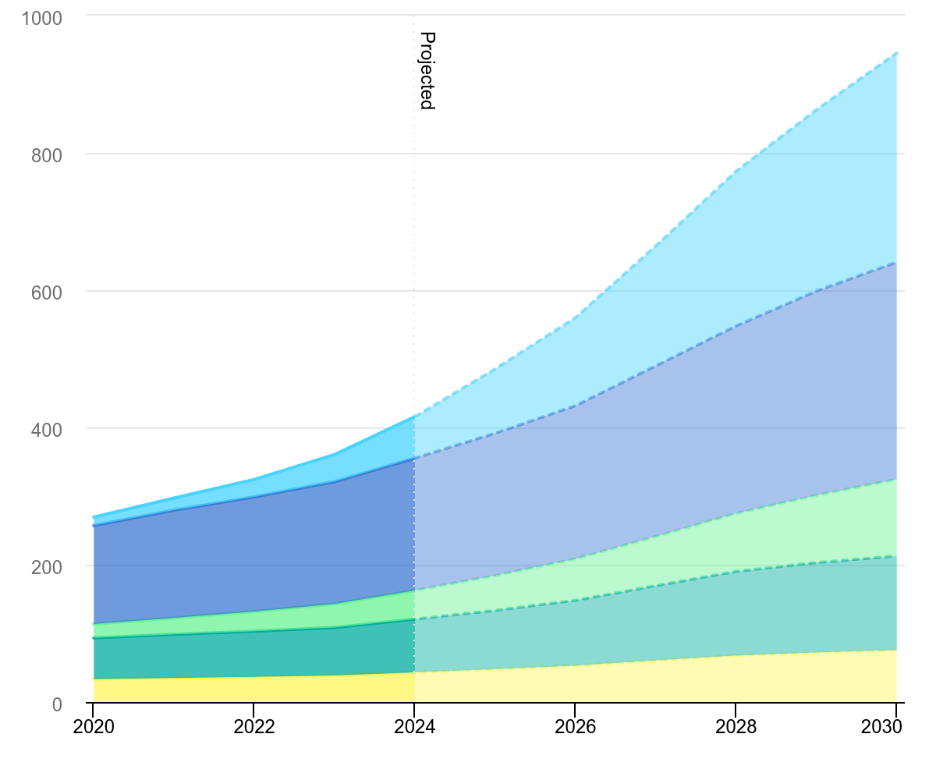
– IEA (2025), Global data centre electricity consumption, by equipment, Base Case, 2020-2030, IEA, Paris https://www.iea.org/data-and-statistics/charts/global-data-centre-electricity-consumption-by-equipment-base-case-2020-2030, Licence: CC BY 4.0
During AI training and inference alone, large-scale GPU clusters can create power fluctuations worth hundreds of megawatts within seconds. This brings a challenge to the reliability of grid operations.
AI workloads operate differently from traditional cloud or web processing within these facilities. The load profiles are cyclical, driven by training and inference cycles where all servers process simultaneously, producing enormous bursts of power consumption. Traditional workloads, by contrast, maintain a much steadier electrical draw. This shift from predictable to high-intensity, cyclical demand is what makes AI infrastructure a fundamentally different engineering challenge, and it changes everything about how a data center plans and manages power.
The Impact of AI Workloads on UPS and Batteries
AI data centers are engineered to accommodate extreme power demands. What continues to evolve, however, is the intensity and unpredictability of the load patterns that UPS systems must now contend with. AI workloads trigger high-intensity bursts of electricity in milliseconds, and a UPS not specifically designed for these fluctuations risks voltage drops that can compromise the entire system.
The stress extends to the battery arrays as well. Frequent power swings accelerate battery degradation, leading to earlier-than-expected replacements and a quietly eroding safety margin, even in systems that appear to be functioning normally.
This is precisely where Falcon’s online double conversion UPS product line becomes a differentiator. Unlike standby or line-interactive designs, online double conversion continuously regenerates clean, stable output power — completely isolated from input disturbances. In an AI data center environment where power quality and response time are non-negotiable, this architecture is the standard that infrastructure demands.
Is Your Power Infrastructure Ready for AI?
For data center developers, engineers, and project managers working on AI infrastructure, power and utility requirements have become the foundation of the entire planning process. Electricity supply, load capacity, and redundancy are among the first variables scoped before a single rack is installed.
The real question isn’t whether to plan for power. It’s which UPS technology is the right fit for the demands ahead. Falcon’s online double conversion UPS systems are engineered for exactly this environment, delivering continuous clean power, zero transfer time, and the reliability that mission-critical AI infrastructure requires.
Explore our UPS solutions — the same ones that help protect mission-critical infrastructure across industries. Our 35+ years of engineering expertise has earned us a reputation for building military-grade, high-reliability power solutions. We bring that same level of excellence to every customer we serve, no matter the size or industry.
Key Takeaways
- AI workloads are pushing data center power density from the traditional 15 kW per rack up to 120 kW, changing how power infrastructure must be planned.
- Unlike conventional IT workloads, AI operates in cyclical bursts of high-intensity power demand, making electrical loads far less predictable and harder to manage.
- Frequent power fluctuations from AI workloads accelerate battery degradation, causing UPS systems to silently lose their safety margin faster than expected.
- Online double conversion UPS systems are the right architecture for AI data centers, as they continuously regenerate clean output power and eliminating the transfer time gaps that high-intensity, cyclical loads expose.
Latest Posts
Telecom UPS Systems: Powering Connectivity & Critical Infrastructure
The telecommunications industry is the backbone of our connected world, enabling everything from daily communications to mission-critical infrastructure. But that backbone is only as strong as… Read Post
Lithium-Ion UPS Battery vs. VRLA: The TCO Equation for Modern Data Centers
For decades, the data center industry has relied on a familiar, heavy, and high-maintenance technology to keep the lights on during power anomalies: the Valve… Read Post
Railway Signaling Backup Power: Eliminating the Single Point of Failure
Rail signals fail because power distribution fails first. It fails when a dual-control switch machine loses terminal voltage mid-stroke, leaving the points unlocked. It happens… Read Post