Power Load Is Surging. Is Your Data Center Ready for the AI Era?


For decades, we have relied on stable, foreseeable power loads. We could size our infrastructure, budget for energy costs, and trust that the grid would deliver what we needed, when we needed it. But things are changing, and that assumption is outdated.
The modern power landscape has shifted because of the rising demand from AI and data centers, showing an accelerating shift to intermittent renewables and an aging grid that was never designed for the volatility we’re asking it to absorb today. The result is an environment where power quality and availability are increasingly volatile, and where organizations that haven’t prepared for that unpredictability are paying a steep price.
If your operations depend on any kind of critical equipment such as servers, telecommunications systems, industrial machinery, medical devices, or networked infrastructure, this is a problem you can’t afford to treat as someone else’s concern.
The changing landscape in power consumption
Electricity demand across the U.S. had been nearly stagnant for over a decade, averaging just 0.1% annual growth from 2008 to 2021. Then in 2024, it rose by 3.0%, the fifth-highest level of growth this century. One of the possible primary drivers? Data centers.
S&P Global says that by 2028, there will be around 50 GW of data center capacity. With the increasing demands for AI-related computing power, data centers are bound to consume a lot more power than before. However, the aging U.S. grid needs upgrades and expansions to keep up with the rapid increase in power consumption.
The challenges of the modern load profile
The infrastructure carrying all this power is itself a growing liability:
| Percentage and Components | Years |
| 70% of power transformers (in the U.S.) | ~25 years or more |
| 60% of circuit breakers | ~30 years or more |
| 70% of transmission lines | ~25 years or more |
The infrastructure is designed for a world with predictable, centralized generation and slow-changing demand curves. We are now running that infrastructure hard under conditions it was never engineered to handle.
The transition to renewable energy adds another layer of complexity. Solar and wind now represent a significant and growing share of generation, but their output varies with weather conditions. Pairing intermittent generation with volatile demand creates swings in power quality (e.g., voltage sags, surges, and frequency deviations) that affect facilities, equipment, and operations.
On top of structural demand and infrastructure challenges is a worsening climate pattern directly amplifying outage risk. Extreme weather events such as storms, heat waves, and droughts led to widespread power disruptions in 2024, with large-scale outages affecting different countries and regions across the globe. In the U.S. alone, major winter storms in early 2024 caused multi-state blackouts, and the Atlantic hurricane season brought severe disruptions across some U.S. states and Caribbean nations.
Between 2018 and 2024, there was an increase in the number of major power outages in the U.S. The statistics rose to 29%, going from 4,666 to 6,533, with the average major outage lengthening from 9.6 hours to 11.8 hours. The total annual burden of major outages on U.S. customers climbed to $121 billion in 2024, a figure that reflects how much more expensive each disruption has become as our dependence on continuous power deepens.
What power unpredictability can cost your organization
Power unpredictability directly affects operational risk, financial exposure, and reputational consequences.
The cost of downtime has become increasingly severe across industries. Outages costing more than $1 million rose from 16% of incidents in 2023 to 20% in 2024. In Uptime’s 2024 annual survey, 54% of the respondents stated that their significant outage cost over $100,000. These aren’t just data center or IT problems. The Siemens 2024 True Cost of Downtime report found that unplanned downtime costs the world’s 500 largest manufacturers $1.4 trillion annually, representing 11% of their total revenues.
For organizations that depend on servers, networked systems, or sensitive industrial equipment, the exposure is direct and significant. A few hours of downtime don’t just translate to lost productivity in the immediate term. It can mean corrupted data, hardware damage that requires replacement, regulatory penalties, and customers who don’t come back.
How a reliable and sturdy UPS ensures protection for your mission critical infrastructure
The reality of current power environments is that we can’t control what happens on the grid, but we can control what happens at the point where the grid meets our critical systems. And that’s where an Uninterruptible Power Supply (UPS) operates.
A UPS is more than a battery backup device that’s useful only during blackouts. Modern UPS systems serve as a continuous buffer and power conditioner between incoming utility power and the equipment that depends on it. A UPS detects power failures or fluctuations and instantly switches to battery power, converting AC to DC for storage and back to AC for connected devices. This process ensures seamless transitions that prevent damage and data loss, and its protection extends well beyond total outages.
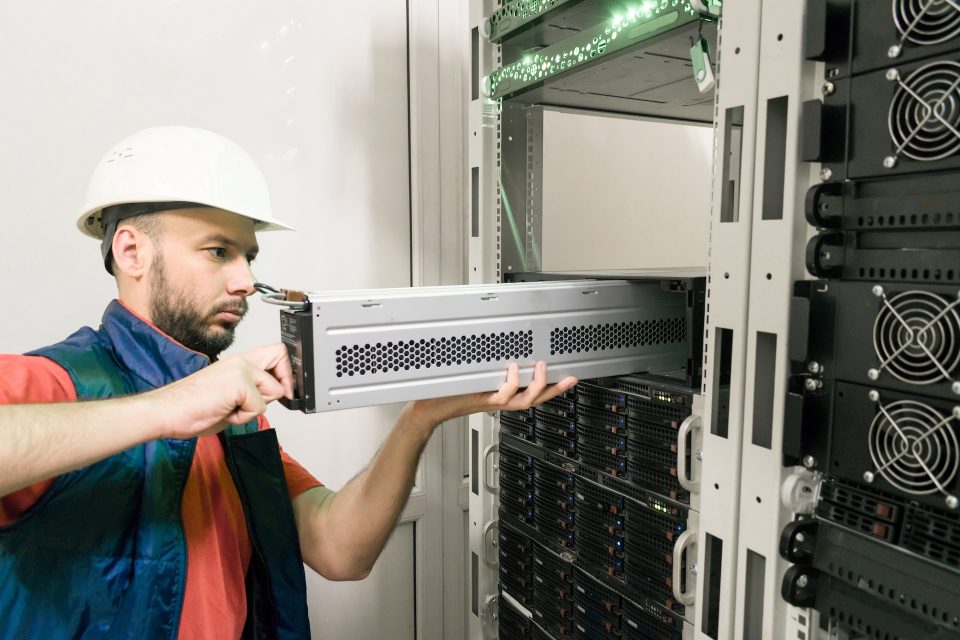
Voltage surges, sags, and brownouts are some examples of power quality events that are becoming more common as grids face volatile demand and intermittent generation. These are threats that a high-quality UPS actively filters and corrects. They adjust incoming voltage to safe levels without drawing on the battery and protect sensitive equipment from the cumulative damage caused by ongoing power instability.
For companies running data centers, manufacturing lines, telecommunications equipment, or any infrastructure where seconds of interruption carry serious consequences, the right UPS solution provides multiple layers of value:
- Continuity to keep critical systems operational during outages long enough to transition to backup generation or execute a controlled shutdown.
- Power conditioning that delivers clean, stable power, protecting sensitive equipment from the slow damage caused by voltage fluctuations and power quality events.
- Data integrity prevents corrupted or lost data that results from unexpected system shutdowns.
- Compliance and SLA protection help maintain uptime commitments that have contractual and regulatory implications.
UPS systems are essential in modern power infrastructure, ensuring seamless shifts between grid power and backup power. These help keep critical infrastructure like data centers) operational and minimize threats that come with power outages.
Modern UPS solutions are also increasingly modular and scalable, growing alongside your infrastructure without requiring a full replacement every time your power requirements change. For project managers planning facility upgrades, technology refreshes, or new deployments, this scalability is a meaningful factor in the total cost of ownership.
Summary
Surging AI-driven demand, an aging grid under pressure, and extreme weather events have combined to make power loads more volatile and outages more costly than at any point in recent history.
A UPS is an essential component of resilient infrastructure in today’s unpredictable power environment. The right solution, properly specified and maintained, ensures that what happens on the grid doesn’t determine what happens to your operations.
Protect your critical systems from power unpredictability. Browse our full range of UPS solutions to find what fits your infrastructure needs.
Do you have questions about sizing, configuration, or finding the right fit for your environment? Our team is ready to help. Contact us through our website.
Key Takeaways
- The U.S. power grid is under growing strain from AI-driven data center demand, aging infrastructure, and increasingly volatile weather events.
- Major power outages in the U.S. increased by 29% between 2018 and 2024, costing businesses an estimated $121 billion annually.
- Power instability goes beyond full blackouts. Voltage sags, surges, and brownouts are becoming more frequent and damaging to critical equipment.
- A modern UPS does more than provide backup power, as it continuously conditions incoming power to protect sensitive systems from cumulative damage.
- For organizations running mission-critical infrastructure, a properly specified UPS is crucial for operational resilience, not just as an optional safeguard.
Latest Posts
Telecom UPS Systems: Powering Connectivity & Critical Infrastructure
The telecommunications industry is the backbone of our connected world, enabling everything from daily communications to mission-critical infrastructure. But that backbone is only as strong as… Read Post
Lithium-Ion UPS Battery vs. VRLA: The TCO Equation for Modern Data Centers
For decades, the data center industry has relied on a familiar, heavy, and high-maintenance technology to keep the lights on during power anomalies: the Valve… Read Post
Railway Signaling Backup Power: Eliminating the Single Point of Failure
Rail signals fail because power distribution fails first. It fails when a dual-control switch machine loses terminal voltage mid-stroke, leaving the points unlocked. It happens… Read Post